
Success in business is indeed often gauged by the attainment of desired outcomes and the ability to generate favorable results. Productivity plays a crucial role in this context, serving as both a driver and a measure of success. An increase in productivity typically indicates more efficient use of resources, which can lead to higher profitability, market share, and customer satisfaction. These factors are commonly used as benchmarks to assess the performance and success of a business. In essence, productivity and success are interlinked, with each one reinforcing the other in a cycle that promotes growth and achievement in the business world.
Success is a concept that resonates globally, yet its definition is as diverse as the population seeking it. Generally, success can be viewed as the achievement of a set of goals, whether personal, professional, or societal. However, the true inputs for achieving success are often debated. Commonly cited factors include hard work, determination, and a positive mindset, but the formula can vary greatly depending on individual values and cultural perspectives. Moreover, success is not just about the endpoint but also about the journey and the growth experienced along the way. It’s a multifaceted pursuit that encompasses learning from failures, adapting to changes, and persisting despite challenges. Ultimately, defining success is a personal endeavor, and its achievement is a testament to one’s dedication and approach to life’s myriad opportunities and obstacles.
The first lesson to learn is that success is not merely an outcome but a process. It’s a culmination of causes and effects, where the future holds the fruits of today’s labor. Many aspire to achieve success without fully engaging with the necessary causes that lead to it, not realizing that every effect is the result of a preceding cause. It’s essential to understand that the seeds we sow today are the harvest we reap tomorrow. This principle is fundamental in recognizing that success is built on a foundation of actions and decisions.
The pursuit of success is indeed closely tied to the quality of one’s actions. Proper and well-considered actions can set a strong foundation for future success, while actions that are hasty or ill-conceived may lead to less favorable outcomes. It’s a reminder that every step we take today, shapes our tomorrow, and that diligence and precision in our actions are crucial for achieving the goals we set for ourselves.
The triad of concentration, consistency, and cooperation indeed forms a robust foundation for success in any business endeavor. Understanding and implementing these principles can significantly enhance productivity and effectiveness, transforming them from mere buzzwords into tangible results. It’s the meticulous application of these concepts that often distinguishes thriving businesses from the rest.
When these elements are deeply understood and skillfully applied, they form a robust foundation for success, enabling businesses to navigate challenges and capitalize on opportunities with agility and resilience.
Concentration
Concentration indeed is a vital skill that involves the intellect’s* ability to maintain the mind’s* focus on the present moment. It’s an art that requires practice and discipline, as the mind often wanders to past experiences (worries) or future uncertainties (anxiety). Developing a strong intellect can enhance one’s ability to concentrate, thereby improving productivity and mental clarity. By training the mind to stay engaged in the now, one can harness the full potential of their cognitive capabilities.
Consistency
Consistency is the key to mastery in any field. Just as a steady stream of water can carve through rock, consistent effort can lead to breakthroughs in personal and professional endeavors. It’s the disciplined repetition of actions aligned with one’s goals that builds the momentum necessary to overcome obstacles. In sports, as in life, those who dedicate themselves to consistent practice, focusing their energies in a singular direction, are often the ones who achieve greatness. This unwavering commitment to a chosen path is what separates the exceptional from the average.
Cooperation
Cooperation is indeed a cornerstone of success in any collective endeavor. It’s the harmonious cooperation of individuals that enables businesses, communities, and nations to overcome challenges and achieve shared goals. History has shown us that when people unite their efforts with a common purpose, remarkable transformations can occur. From the post-war reconstruction of nations to the founding of new countries, cooperation has been a driving force behind progress and prosperity. Embracing this spirit of teamwork and mutual support is essential for success in any field, as it fosters an environment where collective intelligence and effort lead to outstanding outcomes.
Maintaining the above 3 disciplines, your actions should spell success and productivity, progress and peace in any field of endeavor.
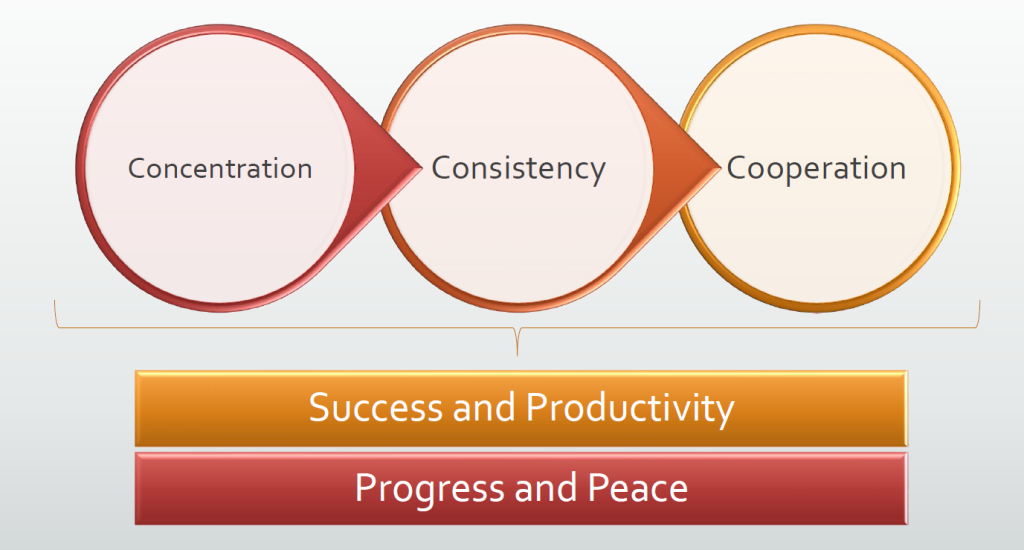
Together, these principles transcend mere managerial jargon, becoming the very fabric of productive output and success. Incentives may motivate, but they cannot replace the foundational disciplines that govern the mechanics of productivity and the attainment of goals.
It’s important to note that success is a personal and subjective concept, and what constitutes success for one person may not be the same for another.
What does success mean for you and what is your formula?
Terminology*:
- Mind: An equipment of the Body. The mind is composed of feelings, emotions, like & dislikes, allows the body to experience joy, sorrow, love, hatred, passion, anger, etc.
- Intelligence: Gained from information and knowledge through external sources – teachers, textbooks, schools/universities, etc. An individual then becomes informed and knowledgeable in the subject allowing them the means to make a living.
- Intellect: Intellect is not intelligence. Intellect is the faculty to think, to reason, to judge, to decide on the pros and cons of life. Having an intellect allows an individual to question, enquire and not to take anything for granted.
- Concentration: Technique exercised by your intellect to hold the mind on the present action without allowing it to slip into the past or future.
- Consistency: The technique of channelizing your actions towards the goal.
- Cooperation: When the intellect maintains a true spirit of cooperation among those concerned in the business.
References*:
- The Fall of Human Intellect, Author: A. Parthasarathy
- Governing Business and Relationships, Author A. Parthasarathy