The inspiration for this article comes from several recent customer engagements and last-minute requests for assistance related to Microsoft’s upcoming Project Online retirement.
Surprisingly, a number of organisations either had not fully realised the significance of the retirement announcement, underestimated the effort involved in migrating, or had simply not yet begun their migration planning. In some cases, customers only started exploring replacement options after discovering that the retirement deadline was only weeks away.
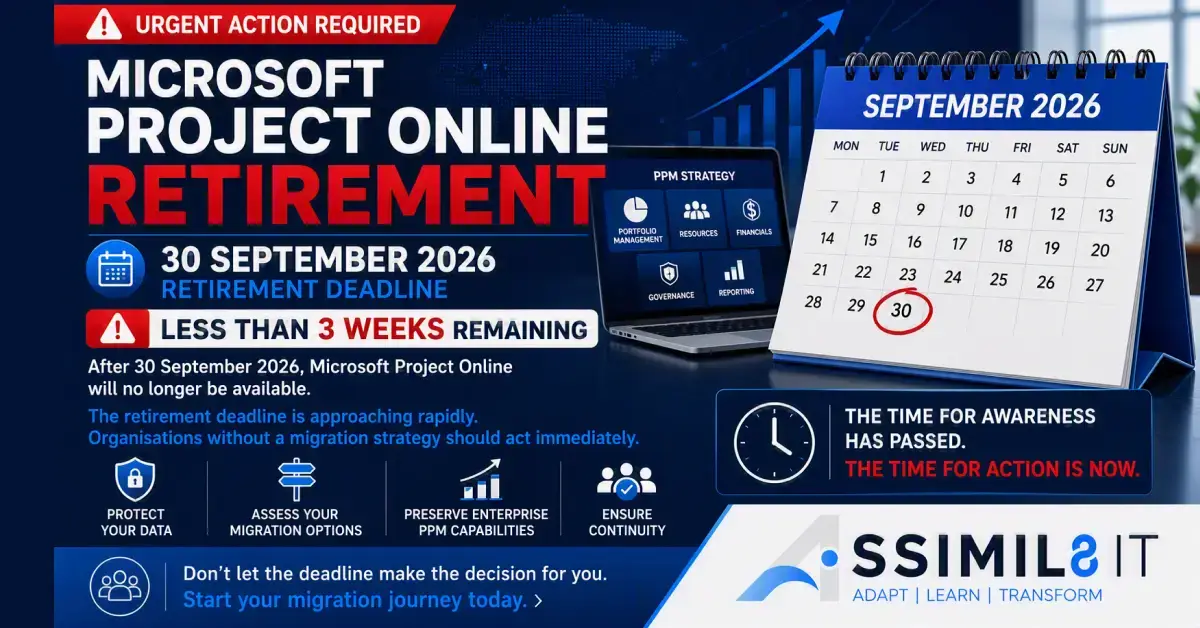
With less than a month remaining before Microsoft retires Project Online on 30 September 2026, many organisations are now finding themselves under increasing pressure to evaluate replacement solutions, assess migration approaches, and make strategic decisions that may impact their Project Portfolio Management (PPM) capabilities for years to come.
Unfortunately, urgency often creates opportunity for the wrong kind of advice.
When organisations are faced with looming deadlines, they naturally seek guidance from partners and consultants who position themselves as subject matter experts. However, recent engagements have highlighted a concerning trend in the market. Customers are increasingly being presented with solutions, migration approaches, and recommendations that appear to prioritise speed of sale and vendor revenue over long-term customer success.
As Project Online reaches the end of its lifecycle, organisations are being forced to make significant technology decisions involving governance, portfolio management, resource planning, financial controls, reporting, integrations, security, and future scalability. These decisions should not be driven by marketing messages, product demonstrations, or one-size-fits-all accelerators. They should be based on a thorough understanding of the customer’s current environment, business processes, strategic objectives, and future roadmap.
This is precisely where the cost of false expertise becomes most apparent.
A customer can meet the migration deadline and still ultimately fail if they migrate to the wrong platform, lose critical functionality, create unnecessary technical debt, increase operational costs, or adopt a solution that does not align with their long-term business requirements. In many cases, the true cost of poor advice only becomes visible months or years after the implementation has been completed.
Having worked extensively with Microsoft’s Project and Portfolio Management solutions for more than two decades, from Microsoft EPM 2003 through to Project Online and today’s modern Power Platform-based PPM solutions, I have had the privilege of working alongside highly skilled consultants and reputable partners who have invested heavily in developing genuine expertise in this specialised field.
Unfortunately, the retirement of Project Online has also exposed the difference between partners who truly understand Project Portfolio Management and those who simply see an opportunity to sell another licence, another migration project, or another implementation engagement.
The question organisations should be asking is not:
“How quickly can we move?”
The more important questions are:
“Are we moving to the right solution?”
“Does the recommended platform align with our requirements?”
“Is our advisor solving a business problem or simply selling a product?”
Those questions sit at the heart of the true cost of false expertise.
The Difference Between a Competent Project Partner and a Vendor Looking for a Sale
One of the most important lessons reinforced through recent customer engagements is that there is a significant difference between a competent Project Portfolio Management partner and a vendor whose primary objective is simply to win the business.
A competent Project Partner begins by seeking to understand the customer’s environment.
They invest time in assessing the organisation’s current Project Online implementation, understanding business processes, reviewing governance requirements, evaluating reporting and resource management practices, identifying customisations and integrations, and discussing future strategic objectives. Their recommendations are driven by what will deliver the best long-term outcome for the customer, even if that means proposing a more complex approach, involving specialist expertise, or recommending a solution that generates less immediate revenue.
A vendor focused solely on securing the opportunity often approaches the engagement differently.
The conversation quickly shifts towards products, licensing, demonstrations, and migration promises before a thorough understanding of the customer’s requirements has been established. The recommendation may be based on the solution they are most familiar with, the product they are incentivised to sell, or the quickest route to closing the deal, rather than what is genuinely best for the customer.
This distinction becomes even more important as the Project Online retirement deadline approaches.
Under pressure to meet timelines, organisations can easily be persuaded by promises of rapid migrations, pre-packaged accelerators, or “one-size-fits-all” approaches. While these may appear attractive initially, they often overlook critical factors such as:
- Existing business processes and governance requirements
- Portfolio and resource management maturity
- Reporting and executive visibility requirements
- Integration dependencies
- Financial management capabilities
- User adoption considerations
- Future scalability and innovation requirements
A competent partner asks difficult questions before recommending solutions.
A vendor often arrives with a solution before fully understanding the problem.
A competent partner is prepared to challenge assumptions, identify risks, and sometimes advise against a proposed approach if it is unlikely to deliver the desired outcome.
A vendor is more likely to focus on overcoming objections that may prevent the sale from progressing.
Perhaps the simplest distinction is this:
A vendor measures success by winning the project.
A competent Project Partner measures success by the customer’s outcomes years after the project has been delivered.
As organisations make critical decisions about their Project Online migration and future PPM strategy, the choice of advisor may prove to be just as important as the choice of technology platform itself.
The right partner will help customers navigate complexity, avoid costly mistakes, and establish a roadmap that delivers sustainable value.
The wrong advisor may simply help them move faster in the wrong direction.
This is why the retirement of Project Online is not merely a technology migration exercise.
It is a test of whether organisations are receiving advice from trusted advisors committed to solving business problems, or from vendors focused primarily on securing another deal.
The best partners do not sell the fastest solution. They help customers make the right decision.
The Difference Between Selling and Solving
A true subject matter expert begins by asking questions:
- What business challenges is the client trying to solve?
- What capabilities are being used within the current environment?
- Which customisations are critical to business operations?
- What future roadmap does the organisation envisage?
- What governance, compliance, and reporting requirements exist?
The goal should never be to sell a product.
The goal should be to solve a business problem.
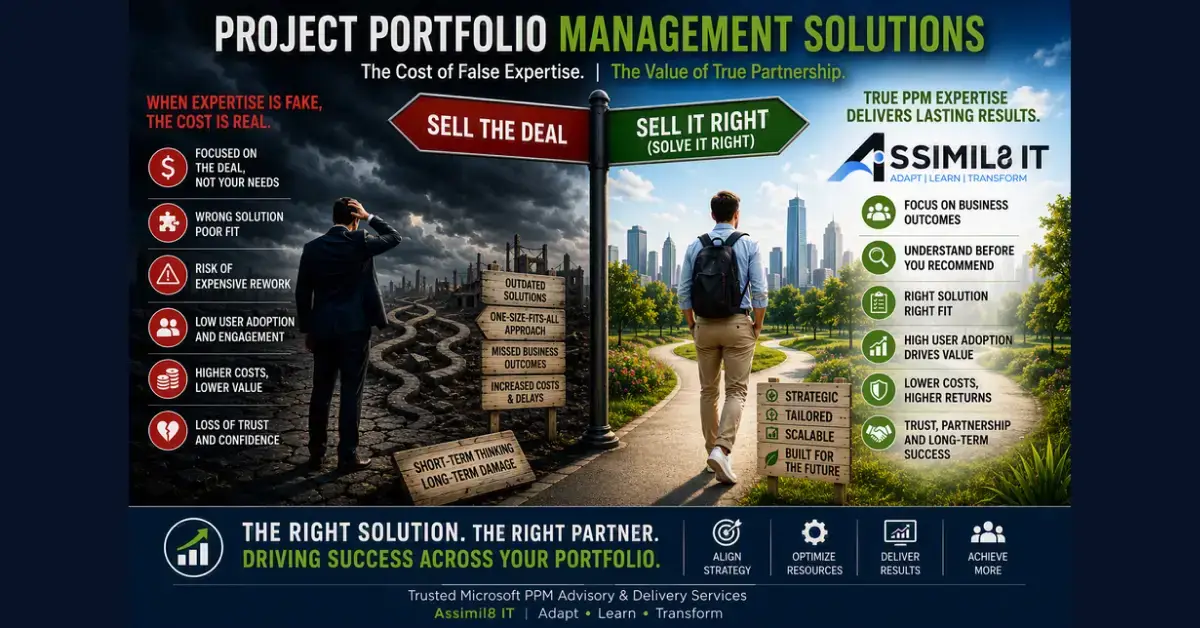
When partners prioritise revenue over outcomes, clients frequently find themselves locked into solutions that do not meet their requirements, require expensive rework, or limit future growth and innovation. In many cases, organisations only discover these shortcomings after significant investments have already been made.
Expertise Requires Humility
One of the most concerning behaviours in the industry is the unwillingness of some vendors to seek advice or collaborate with specialists who possess deeper expertise in the PPM domain.
No individual or organisation can claim to know everything.
The most successful projects are often delivered by teams willing to leverage the best available expertise, regardless of where that expertise resides.
Technical competence is not demonstrated by having all the answers.
It is demonstrated by understanding the limitations of your knowledge and engaging the right experts when necessary.
The Impact on Customers
The consequences of poor solution positioning can be significant:
- Unnecessary migration costs
- Loss of critical functionality
- Reduced user adoption
- Inaccurate portfolio reporting
- Increased technical debt
- Lengthy remediation projects
- Erosion of stakeholder trust
- Low return on investment
- Delayed business benefits
- Poor executive visibility
Most importantly, organisations may miss the opportunity to modernise their Project Portfolio Management capabilities through solutions that genuinely align with their strategic objectives.
A Call for Responsible Consulting
The Microsoft ecosystem has always thrived when partners act with integrity and place customer outcomes ahead of short-term commercial gain.
As trusted advisors, we have a responsibility to recommend what is right for the customer, even when that recommendation may not result in the largest immediate opportunity.
Customers deserve partners who listen before they prescribe, who understand before they recommend, and who prioritise long-term business value over short-term revenue.
In a rapidly evolving PPM landscape, genuine expertise matters more than ever.
The industry does not need more vendors claiming to be specialists.
It needs more professionals committed to a simple principle:
Sell It Right, Or Do Not Sell It At All.
The true measure of a consulting partner is not the size of the deal they win, but the success their customer achieves years after the project is complete.
Because when expertise is real, value endures. When expertise is false, the customer pays the price.